
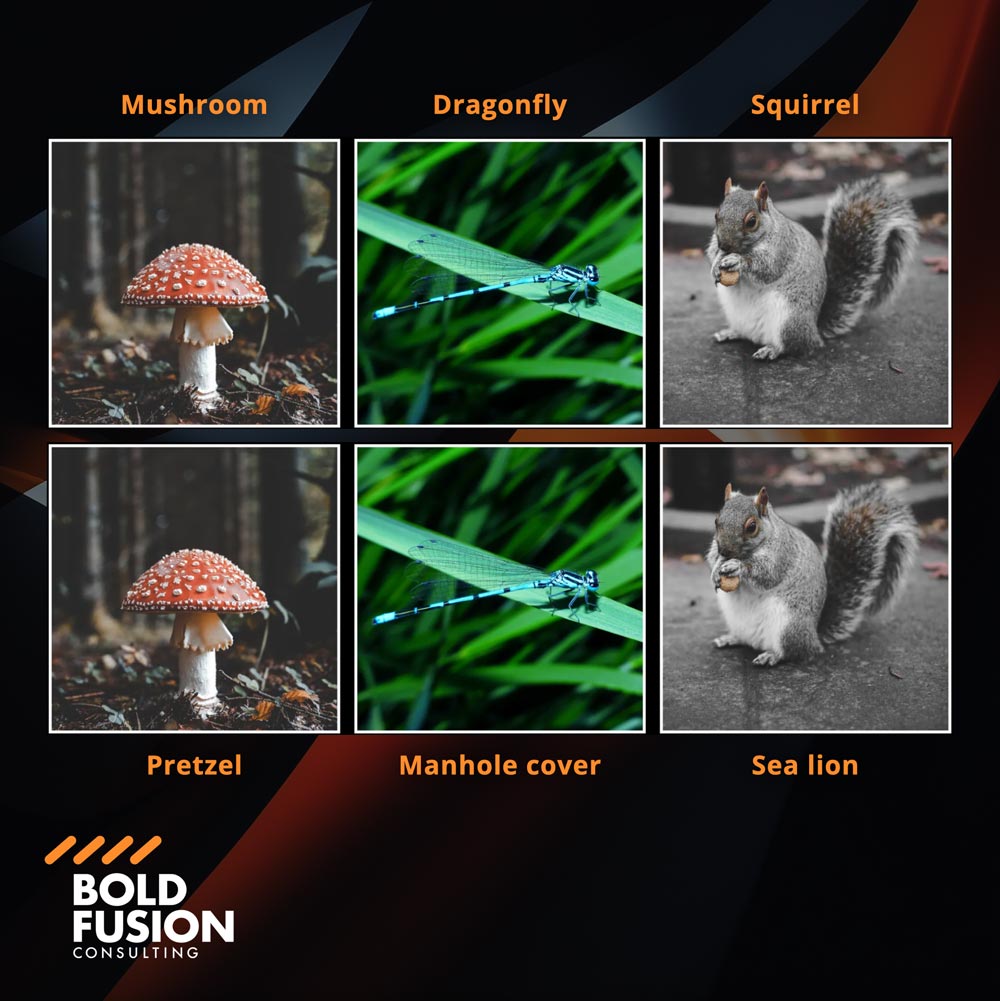
If the top and bottom images look the same to you, congratulations – you’re human! But for AI, it’s a different story:
There’s a difference between those two images, so subtle that only AI image recognition can detect it. You, as a human, can’t.
→ And that’s why AI correctly labels the upper image, but mislabels the lower one.
What your human eye can’t detect is that researchers have added subtle noise to the lower image, completely throwing off the AI’s image recognition. The researchers didn’t add another image resembling the mislabeling content – they just added digital noise.
This vulnerability is called adversarial examples, and it raises a critical question:
→ How much does AI really “understand” the world?
AI doesn’t “see” the way we do. It learns to identify objects by analysing patterns in pixels. Feed it enough labeled images of squirrels and dragonflies, and it associates specific pixel arrangements with each animal.
→ But AI doesn’t recognise a dragonfly as a dragonfly.
It doesn’t know how it flies, lands on a leaf, or where it lives.
It only “sees” pixel patterns.
In this example, adding imperceptible noise to the image of a dragonfly is enough to trick AI into confidently labelling the content of the picture as a manhole cover.
→ AI’s ability to recognise objects in images is revolutionary, but it’s far from perfect.
For creative industries, this is especially important:
↳ AI image generators don’t truly understand the content they create.
Without deeper real-world understanding, humans are still essential for interpreting images and assigning them the meaning they’re meant to convey.